среда, 8 января 2014 г.

Antaryāmitva in Śrī Deśika’s Stotras – A Brief Study (M K Srinivasan)


Antaryāmitva in Śrī Deśika’s Stotras – A Brief Study (M K Srinivasan)


Among  the  five  modes  (prākāras)  of  Śrīman  Nārāyan‹a,  the  Para  and  Vyūha  forms  are transcendental. 

The Vibhava forms occur occasionally. 

The Arca forms are found in temples and are easily accessible to all. 

The Antaryāmin exists in every individual but generally remains unseen. 

According to the Nārāyana Anuvāka (12) 


the Antaryāmin Bhagavān resides in the tiny steady flame in the heart region. 

Sage Yājñavalkya describes Him in the Brihadāranyaka Upanishad (III:7:3) as follows.


He Who resides in the earth, within the earth, but Whom the earth is not aware of, Whose body the earth remains, directs the earth from within, is the inner self (ātmā), the Controller (antaryāmin) and He is immortal (amrtah).  

The sage makes the same statement indicating His presence in the remaining four elements, the five sense organs, sun, moon, stars, space, ether, light, darkness, individual soul, semen, mind, breath, all  beings,  etc.  

This  establishes  the  Brahman  as  the  Indwelling  Self  in  both  sentient  and  non- sentient entities who controls and rules them from within.  

Lord Krishna also says in the Bhagavad Gītā [X-20(a)]: “I am the Self residing in the hearts of all beings.”

The  Antaryāmin  can  be  perceived  only  through  intense  meditation.  

The  common  people  cannot visualise Him, much less express Him. 

Only seers, mystics and highly evolved souls can see Him. 

The  Ālvārs  have  perceived  Him  and  have  made  several  references  to  the  Antaryāmin  in  the Divyaprabandhas. A study of these references will be exhaustive. 

Svāmi Deśika also, in many of his stotras, has touched upon the Antaryāmin aspect besides the Arcā form. 

He has visualised Him in  a  rare  and  unusual  manner.  

A  study  of  his  rapturous  references  to  the  Antaryāmin  form  is  a highly rewarding exercise.

In his Śaranāgati Dīpikā (21), Śrī Deśika outlines how seers are able to perceive the divine form of 
the Lord within them through the practice of ashtānga yoga.


Through  practising  yama  and  niyama,  good  men  purify  and  control  their  minds.  By  performing āsana and pranāyāma, they achieve pratyāhāra (turn their senses inward). 

These enable them to focus  their  minds  (dhāranfia)  on  the  Lord’s  form  within.  The  next  step  is  continuous  and uninterrupted  meditation  on  Him  (dhyāna)  which  ultimately  takes  them  to  the  state  of  beatific composure (samādhi).  

Śrī Deśika refers to types of samādhi – savikalpa and nirvikalpa. 

In the first state, the person gets to see on his mental screen the Image of the Lord of his choice which, when continuously practised, leads to the second where the Lord’s infinite svarūpa appears.  

While  the  above-mentioned  verse  outlines  the  general  process  of  ‘seeing’  the  Antaryāmin  form, Svāmi Deśika points out in verse 21 of Śrī Varadarāja Pañcāśat that the Lord Himself, out of His own volition, chooses to reside in the hearts of men.


Śrī  Deśika  wonders  why  the  small  aperture  of  the  human  heart  is  chosen  by  Him  to  reside,  in preference  to  other  grander  areas  such  as  the  Milky  Ocean,  the  bejewelled  canopied  hall  in Śrīvaikuntha, etc. where He can dwell comfortably. 

This is obviously because of His immense love and compassion for His devotees. 

Later on, in the same hymn, in verse 33, Śrī Deśika brings out the benefit to human beings of the Lord’s residence in their hearts as Antaryāmin. 


But for the grace and kindness of the Lord as the In-dweller (antaryāmin) which has impelled them to come closer, men would have ever remained aloof and distant from Him. 

This is a fact. 

Thus the Antaryāmin Bhagavān is a ‘cementing force’ between man and God, says Svāmi Deśika.  

Another benefit is mentioned in verse 14 of the Hayagrīva Stotra. 

Śrī Deśika says that he who enshrines Lord Hayagrīva (the royal Swan) in his mind (mental lake) will acquire mastery in all subjects, which will vie with one another to serve him.   

Now, to become aware of the Antaryāmin and to perceive Him is a hard and arduous task. It is not given  to  everyone  to  do  so.  

But  here  is  an  assurance  given  by  Śrī  Deśika  in  Bhagavad-dhyāna Sopāna  (verse  1)  to  those  who  cannot  go  through  the  strenuous  process  to  visualise  Him.  He  is available so near and for all to see.       


Śrī Deśika says that the indwelling form of the Lord which can be seen only by seers is appearing in a visible concrete form at Śrīrangam. 

Like a collyrium which, when applied to the eyes, enables a person to see hidden objects, like the gem cintāmanfii fulfilling hearts’ desires, like a divine eye among Vedic scriptures, Lord Ranganātha, the Supreme among celestials, has taken residence here to eradicate the sorrows and grant liberation to the helpless and forlorn beings.  

Thus Śrī Deśika brings solace to the common people who are unable to perceive the Antaryāmi Bhagavān in them. 

They can easily fill their minds and hearts with the sight of Lord Ranganātha and get the same beatific feeling.  
A study of the Antaryāmin form in Śrī Deśika’s stotras will not be complete without a reference to some unique forms of the Lord that he perceives in his mind. 
Though, strictly speaking, they do not conform to the Antaryāmin form, they are highly imaginative expressions indicative of Śrī Deśika’s devotion and desire to see Him in many forms.  

First, in the Varadarāja Pañcāśat (verse 47) he prays to Lord Varadarāja as follows.  


(O Varada! May You ever stay in my mind just as You get up at daybreak from Your Couch of Ādiśesa adorned by the imprint of Goddess Lakshmī’s golden bangles on Your neck caused by Her close embrace.)  

What an unusual prayer! 

Only a highly mystic person or a divinely inspired poet like Śrī Deśika can stretch his vision to such heights. With the richness of its imagery and high philosophical import, it is no wonder that this verse is recited as the awakening song (suprabhātam) at the Lord’s temple at Kāñcīpuram.  

Another interesting and unusual form which Śrī Deśika envisages is found in the Vegāsetu Stotra (verse 4). 

This hymn is on Lord Vegāsetu, who is better known as Lord Yathoktakāri or ‘One who acts as bidden’. 

The former name Vegāsetu has arisen because He is supposed to have laid Himself across the river Vegavatī, the form taken by Goddess Sarasvatī who was separated from Brahma due to a misunderstanding, to flood the site where he wanted to perform an aśvamedha sacrifice. 

Here is the verse in reference.


Śrī Deśika desires to keep in his mind the recumbent form of the Lord lying across the river in spate and Who thus enabled Brahmā’s sacrifice to proceed without let or hindrance.  

Elsewhere, Śrī Deśika proclaims that this form is a bridge to cross the ocean of worldy existence and would put an end to the ‘comings and goings of people in this world’.

A third rare picturisation of the Lord in Śrī Deśika’s mind is given in verse 3 of the Paramārtha Stuti, a stotra in praise of Lord Vijayarāghava at Tirupputkuli (near Kāñcī). Let us enjoy the verse. 


Śrī  Deśika  prays  to  the  Lord  to  let  his  mind  be  filled  with  His  beauteous  form  adorned  with ornaments and weapons (astras) and which is seen by His Consorts with unblinking eyes. 

It is seen here that Śrī Deśika envisions young Lord Rāma during the few moments when He was adorned by innumerable astras which He acquired on initiation from sage Viśvāmitra and before He gave them leave to go. 

A prayer for a very unusual and rarely seen form indeed.  

The  most  picturesque  and  enduring  of  these  imagined  forms  of  the  Lord  occurs  in  the  Gopāla Vimśati (verse 14).


Śrī  Deśika  wonders  which  sculptor  has  engraved  in  his  heart  the  picture  of  this  Youth  with  a peacock feather on his head and Whose face is like a sun unto the lotuses of the lovelorn Gopis’ faces.

Śrī Deśika’s fondness for this rare form is seen in another verse (12) of the hymn where he prays that his mind should remember His playful form even on his last journey.  


(May  His  iridiscent  blue  form  like  a  cut  sapphire,  wearing  a  tiara  of  colourful  peacock  feathers framing the curly black tresses on His head and playing on a bejewelled flute lightly sitting on His lips appear as I prepare to leave this world.)  

One can only bow down one’s head in utter reverence to Svāmi Deśika for his vivid portrayals of the indwelling Lord in such inimitable fashion. 

It can perhaps be said that this is an exhibition of another कृष्ण तृष्णा तत्तव (kRRiShNa tRRiShNA tattava), no less significant than that of Śrī Nammālvār who was utterly devoted to Lord Krishna. 

This  humble  piece  is  offered  at  the  feet  of  Bhāgavatas  who  are  appreciative  readers  of  Śrī 
Ranganātha Pādukā. In fact, the subject merits a more elaborate treatment at the hands of scholars. 

 Śrīmate Nigamāta Mahādeśikāya Namah 

Incredibly Great Table from "Shree Sankarshana Samhita"


From "SANKARSHANA SAMHITA Narada Pancaratram" SWAMINARAYANA AKSHARA PITH SANSKRIT 2004

Moreover, a Manuscript of The "Shree Lakshmi-Tantra" is found in one of the oldest libraries of Gujarat

From "SANKARSHANA SAMHITA Narada Pancaratram" SWAMINARAYANA AKSHARA PITH SANSKRIT 2004

Spread of Pancharatra Agamas in India

Guiarat

In Gujarat many Manuscripts, Images, Temples and Inscriptions of Vaishnavism based on Pancharatra Agamas are found. 

The Oriental Institute of the M.S. University has vast number of manuscripts of Pancharatra Agamas. 

In Rajasthan's Indological Institute of Udaipur there is a bunch of Pancharatra Manuscripts, bearing serial no. 200, written in the Devanagari script, on the palm-leaf material which consists of 86 folios, each measuring 14" x 7". 

And on the front page there is a statement in Gujarati by the scribe Gopiram, "from folio 51, one adhyaya is missing". 

The manuscripts are of 1818 CE. 
Moreover, a Manuscript of The "Shree Lakshmi-Tantra" is found in one of the oldest libraries of Gujaratnamely Dahilakshmi Library, Nadiad.

"SANKARSHANA SAMHITA Narada Pancaratram" SWAMINARAYANA AKSHARA PITH SANSKRIT 2004


DOWNLOAD (Sanskrit with English Exordia):

YandexDisk  Cubby  Box  Dropbox  Bitcasa  GoogleDocs  Skydrive Copy Yunio

The Masterpiece Edition from Shree SwamiNarayan Sampradaya. 

English Exordia is on the page 36. 

Всё для любимой жены


Я всё время думаю над тем, как Кришна заранее всю мою жизнь устроил так, чтобы я жила не напрягаясь, а именно:

А) Кришна настроил вокруг кучу магазинов (есть даже индийский в 6 минутах от дома, что является чудом для Москвы). В этом году Кришна даже построил огромный "Перекресток", по которому я скитаюсь словно призрак. 

Б) С детства поселил меня жить прямо рядом с парком, чтобы не повредить мои лёгкие. 

Кстати, парк мне очень пригодился, потому что по нему удобно скитаться, повторяя Мантры. У меня в гороскопе даже есть особенное сочетание грах, которое указывает на то, что я буду Вайшнава-бхактом, который будет знать очень много Кришна-Мантр и будет скитаться по лесам.

В) Кришна даровал мне рождение именно в ту эпоху, в которую мои Меркурианские наклонности (изучение языков и Вайшнавских Книг) смогли раскрыться в экстремальной степени. Если бы я даже родилась на 10 лет раньше, то всё было бы намного хуже, потому что ещё лет 10 назад возможностей для образования и обучения было очень немного. Нормальные Книги на Санскрите и Хинди стали появляться на archive.org и в Интернете только где-то с 2011 года. 

Я просто молюсь на сайт sadagopan.org, на котором Рамануджа-Сампрадайя размещает настолько бесценные Книги Шри Шримад Веданта Десики, что становится понятно, что я родилась в Сатья-Югу. 
А уж на тему того, как Кришна избаловал меня по всяким мелочам, можно писать массивные трактаты. 
Кришна трясётся надо мной и постоянно защищает, так же как и всех остальных девчонок, которых он собрал здесь для прогресса в "Кали-Югу" (на самом деле для нас всех сейчас идёт Сверх-Сатья-Юга). 


Кришна-Мандир и Кришна-пломбир


В "Перекрёстке" продаётся очень дешёвый пломбир. 

Этот пломбир очень удобно использовать как основу для более сложного мороженого. 

Справа -  вишнёвый сироп и малиновое варенье, которые превратят обычный пломбир в очень яркий ягодный торт-мороженое. 

New bamboo boxes, purchased in one of our warehouse shops


I loved these boxes very much. I have a lot of Ipods (original and clones), so I will keep them in the boxes, because I lose some gadgets very often. 

Новый блокнот (замена для Evernote)


New Notepad. The colour is Red, so I could remember the ideas about The Fury of Shreemati Veera Lakshmi-Devi and Shreemati Durga-Devi all the time. 

Ура, новый блокнот. Цвет - Красный в честь Ярости Шримати Вира-Лакшми и Шримати Дурги-Деви. 

вторник, 7 января 2014 г.

UDIPI KRISHNA and DIGVIJAYARAMA (Shree Madhwacharya and Gopichandana)


Shree Digvijayarama Idol is another important one in the Mission of the Shree Mutt. 

How the Mutt got this, is an Interesting episode. 

Once Shree Madhwacharya was standing on the sea shore. At that time there was a cyclonic storm at the place and the boat was seen to be tossing in the high waves, its captain not knowing the safe direction for navigation. 

Shree Madhwacharya quickly grasped the situation and signalled from the shore, waving his saffron cloth.

The boat, containing valuable merchandise, then started moving towards the shore and reached there safely. 

As Shree Madhawacharya, through His keen insight and His spiritual powers, had guided the boat to safety, the captain was overjoyed and offered him whatever valuables he would prefer to have from among the goods overboard

On the vessel Shree Madhawacharya, leaving all other riches, borrowed Gopichandana blocks and told the captain: "That's enough".
"Swami, when gold and silver are aplenty, how is it You are asking for these Gopichandana blocks", was the reaction of captain. 

"I am a Sannyasi and only Gopichandana will be of use for Me to mark my forehead with Nama', said the Saint. 

He then received them with great joy and purified them by dipping in the holy tank. 
Later, when one of the blocks of Gopichandana was broken for use, something strange happened! 
Yes, inside the block was The Stone Idol of Shree Krishna and a miniature silver throne, designed artistically with scenes from DasaAvatara! 

Likewise, inside the other one was The Idol of Shree Balarama. 

It is The Same Idol of Bhagavan Shree Krishna that is being worshipped by devotees now as "Udipi Krishna" at Udipi. 

The Deity there is blessing all His devotees with happiness and prosperity is too well known to be mentioned here. 

The Shree Balarama Idol was installed by Shree Madhwacharya at Malpe coast itself, for worship. 

To adorn the miniature throne, known as 'Rajatha Peeta', Shree Madhwacharya crafted a suitable Idol in silver of Shree Digvijayarama.

Thus, in the Puja of Shree Mutt, the marvellous Idols of Shree Moola Rama and Shree Digvijayarama occupy important places among Others of Splendour, like the Jaya Rama and Sri Vaikuntha Vasudeva Idols. 

Besides, two Saligramas that Shree Madhwacharya had obtained from Shree Veda Vyasa, are also worshipped during the daily rituals of the Mutt.

SHREE MOOLARAMA DEVARU


I have amended the order of the article, so the list of deities  who worshiped Sri Moola Ramadevaru is at the start. 

                        SHREE MOOLARAMA DEVARU


A list of deities  who worshiped Sri Moola Ramadevaru before Sri Madhvacharya:

  1. Sri Brahma
  2. Jabali Maharshi
  3. Maha Rudra
  4. Daksha Prajapati 
  5. Parvati
  6. Saubhari Maharshi
  7. Sri  Brahma
  8. Surya
  9. Vaivasvata Manu
  10. Ikshvaku 
  11. Mandhata
  12. Trishankala 
  13. Avaranya 
  14. Harishchandra 
  15. Aja
  16. Dasharatha 
  17. Lord Sri Rama 
  18. Lakshmana 
  19. Grutsnamada
  20. Hanuman 
  21. Bhimasena 
  22. Draupadi 
  23. Parikshita 
  24. Janamejaya 
  25. Kshemaka 
  26. Vishnuvarma

 Vishnuvarma was the prime minister of Kshemaka. He gave these icons to  Gajapati Dynasty of Orissa

SHREE MOOLARAMA DEVARU - HISTORY

These Idols got through Naraharithirtha and worshipped by Acharya are very ancient, popularly known as "Chaturyugamurthis". 

There are references about their glorious past in Vasistha Ramayana, Adhyatma Ramyana and Markandeya Purana. 

Both of these idols are very beautiful. 

Any pious soul that takes a darshan of these cannot but have profound devotion aroused. On seeing the idol of Sri Moola Rama an Archaeological official has expressed his bewilderment at the meticulousness of its form,beauty, ancientness. 

Shree Jaganathadasa in one of his kirthanas has narrated history of these Idols in the same cronolgy as has been done by Sri Vadindrathirtha in "Sri Raghavendra-matha-gatharchagathi-krama", a book authored by him. 

Sri Vijayadasa has composed the separate Suladi depicting the events leading to the possession of these idols.

Chathurmukha Brahma rejoices in worshipping God in different ways.These idols were made by Vishwakarma as ordained by Chathurmukha Brahma for the purpose of daily pooja. 

After worshipping them for a long time, Chathurmukha Brahma handed over to Jabalamuni for the benefit of the world. 

They were then worshipped by Shiva and Parvathi, who handed them over to Dakshaprajeshwara. 

The Saint Soubhari worshipped these idols which once again reched to Sathyaloka. 

Vyvaswan then earned these idols through penance from whom they reached the hands of his son Vyvaswatha Manu. 

King Ikshvaku of Surya dynastymade this idols as his kuladevathas and worshipped them.

His descendents in the dynasty, Mandhatha, Anaranya, Thrishanku, Harischandra, Sagara, Bhageertha, Ambareesha, Dilipa and other emperors also worshipped these idols. 

Then the emperor Dasharatha worshipped them with great devotion. He named his eldest son Rama after the name of the Idol which became known as "Moolarama" from then onwards. 

Sri Rama, Sithadevi, Laxmana and Jambavantha worshipped the idols of Moola Sita Rama. 

Then Lord Rama gave these Idols for The Worship to one Vedagarbha, His Devotee who was longing for the darshan of the Lord. 

After worshipping them for some years, Vedagarbha returned them to Sri Rama. 

Then for the period from Threta-yuga to Dwapara-yuga, these Idols were worshipped by Hanumantha. 

When Bhimasena met Hanumantha in the course of his search for Sougandhikapushpa. Hanumantha gave these idols to Bhimasena  and advised him to continue them in his next incarnation as Sri Madhwa in Kaliyuga.

Then Pandavas and all the rulers upto Kshemaka worshipped these idols before they reached the treasury of Gajapathi, the Kalinga ruler. 

Thus, it is needless to say how immense the Divine Presence is in the Idols worshipped by such Great Souls.

When the truth 

प्रतिमायन्तु सान्निध्य्म् अर्चकस्य तपोबलात्। 

is analysed, it is only appropriate to consider these idols as The Real Lord keeping in mind particularly the fact that they were worshipped by none other than Shreemati Laxmi-Devi and Bhagavan Shree Narayana, the Supreme Spirit of the universe, Brahma and by Vayu in all his three incarnations. 

It can be so said here

लोहवद्रुयते हरिः। as शिलावद्रुयते हरिः।I said in Tirupathi. 

Those who merely touch such Sacred Idols are the righteous and the vortuous. 

Puranas quote that the worshippers of these Idols are above human and "Amshapurushas". 

The very darshan of the aslant Lord Rama with drooping ears on a round base is magnificent. 

There is no doubt about just a darshan of a Lord purging us of the heap of our sins.

Only to worship this Idol, Vyasamuni became Raghavendra, Vibhudhendra-Vijayeendra, Jithamitra-Sudheendra. 

In the opinion of the jnanis anyone who worships This Idol in Yathyasharma is certain to attain salvation. It can be definitely said that the Almighty has blessed this world with This Idol for emancipation of his devotees in an age beset with sin.  

Shree Moola Rama even today has enshrined Sri Raghavendra Swamy Mutt, the original samsthana of Acharya.

Incredible Picture


http://www.patwari.org/special/special.html

Works and Sanchara Route map Sri RaghavendraTeertharu


WWW.PATWARI.ORG - Dedicated to Sri RaghavendrateerthaGurusarvabhoumaru


Nava Brindavan

DevatAntara Sambandham as serious Moksha obstacle - Part 02 - "The Bhakati Pradip of Sankaradeva"


ShankaraDeva is The Vaishnava Saint and Acharya, Who preached in Assam (don't consuse with Shankara-Acharya, the founder of Advaita). 

The Bhakati Pradip of Sankaradeva 


The Bhakati Pradip of Sankaradeva is a work complete in 313 verses and deals with the sole devotion to Lord Krishna. 

The facts have been taken from the Garuda Purāna which brings out its topic in the form of a discourse between Krishna and Arjuna just as the Gitā is told:

Garuda Purān Krishna-Arjuna Samvāda

Like most of Sankaradeva's writings, it is almost an original work and he writes freely, of course without departing from the main theme of his source. 

The caritas refer to Bhakati Pradip as an early work of Sankaradeva.

The plot begins when for the performance of the Rājasuya sacrifice various sages assembled and had a discourse on the comparative merit of religious performances:

Yata Devarisi Rājarisi Brahmarisi:
Bhailanta ekatra sehi sabhāt harisi. 10
Yagne dāne vrate moksa kāhāro yuguti:
Keho bole mahā jnān yogat mukuti.
Keho bole sādhe gati ei Rājasui;
Angira Nārade bulilanta kichu nui. 11
Jnān karma yogak karanto mahā kasta:
Alpa chidre kare tāk tetiksane bhrasta.
Rājasuya kari yeve Brahmaloke care:
Punya ksay bhaile dunāi samsārat pare. 12
Bance Brahma lokat ācari tapa yog:
Nāhi eko sukh indriyar mātra bhog.
Māyāmay deva dharma samaste vināsi;
Āto moksa āche suni uthe mor hāsi.13

All the god-sages, king-sages and Brahma-sages gladly assembled on that occasion. 

Some of them opined that sacrifices, gifts and fasting could bring about salvation. 

Others said that salvation could be had by the great cult of knowledge. 

Yet others maintained that only the Rājasuya could lead to final emancipation. 

Hearing these arguments, the sages Angira and Nārada said that these are nothing. 

Jnāna (knowledge), karma (ritual) and Yoga are beset by great hardship; moreover, these become useless on a slight fault [on the practiser?s part]. 

The Rājasuya may raise its performers to Brahmaloka, but when the merits are spent up, he again drops down to the world. 

Besides, when by meditation etc, a person stays in the Brahmaloka, he obtains no bliss, only the gratification of the senses. 

All such faiths relating to the gods are ephemeral (destructible) and full of illusions. It makes me laugh to hear that such religions can bring about salvation.

Superiority of Bhakti

Bhagavan Shree Krishna corroborated this last view:

Bolanta Kesave sunā uttar ihār:
Hauka nara yadyapi param durācār.
Moke mātra bhajay nupuji deva ān:
Tathāpi param sādhu sei mor prān. 34
Nabādhay dose tāk tejio samsay:
Satye satye dibo moksa sakhi Dhananjay.
anācāra kari aparādhi mora nuhi
ānadeva puje yito sei mora drohi. 35
Mahāmoksadātā mot pare nāhi kev:
Tathāpito teji mok puje ān dev.
yito mahāmleccha khāy kukkuraka māri
tāto kari apavitra sito ahamkāri. 36
dekhi bura diba lāge nāi tāta citra
candālaro asprisya ehise apavitra.
Mai nij pitrik karile apamān:
Brahmāndat nāi pāpi tāhār samān. 37

[Krishna said:] Hear my answer to this. 

Be a person a big rogue, but if he worships Me and Me alone, and never worships other gods he must be a great saint and dear to Me as my life. 
No defects can stop him, know it for certain, and I tell you most truly, O Arjuna, that I will deliver him from this world. 
One cannot be sinful to Me by violating the established rules of conduct, but one becomes a sinner to me by worshipping other gods. 

I am the Giver of Salvation (Moksha) and there are none of this power else than Me; if in spite of this, a person worships other gods in preference to Me, then he must be more despised than one who kills dogs to eat their flesh. 

There is nothing to wonder that one who suffers the sight of such a person should immediately purify himself by diving into the water. 

Such a wretch is impure and untouchable even for an outcaste; for he insults Me Who am his own Father. 

There can be no sinner in this universe worse than him.

This however did not convince Arjuna who asked forthwith:

Tomāk nupuji ān deva puji
Cāndālatodhika hove;
Hena viparita kaito natu suni
Cāndālo tāka nochove. 45

I have never heard such an extraordinary thing that a person may become worse than an outcaste, rather untouchable, for even an outcaste, by worshipping other gods in preference to You.

Krishna then told Arjuna an interesting incident how an outcaste woman (Cāndālini) who was devoted to Him actually dived in the sacred Ganges hundred and eight times, and also took to what may be called ?internal washing? by reciting one thousand and one Names of Krishna in repentance, simply for talking with a Brāhmana who used to worship other gods in preference to Visnu.

Meanwhile came Nārada:

Tolanta yantrat nād amrit susvar
Āpuni gāvanta git kanthe kokilar.78
Jagat pavitra hove suni Rām vāni:
Kāstho drave atisay sila srave pāni.
Vriksasavo munjare sarir romāncit:
Ānande hiāt honta Isvar bidit. 79

In his musical instrument he raised a sweet note that showered nectar, and he himself sang with the voice of a cuckoo. 

The world becomes sanctified to hear the glories of Rāma. 

The wood softens and the stone melts into water. The trees blossom and the body feels a thrill of joy. 

And God reveals Himself through joy in hearts.

Nārada who knew all about the outcaste woman, burst into saying:

Dhanya dhanya Cāndālini mati ye uttam:
Nedekhilo Bhakat param toka sam.
Niscay jānili tattva Krishna Devatār:
Tor darasane bhailo āmio nistār. 93
Cārio Vedar tattva tai āchā jāni.
Taisi uttam jāti tai mahā māni.
Tirthak pavitra karā āt kon citra;
Tor sanga pāile huiba jagat pavitra. 94

Glory to you, O outcaste woman. Yours is the happiest intellect.

I have never come cross a devotee equal to yourself.

You have known the real mystery of Love of Krishna.

We are also delivered from this world by your sight.

It is you who have known the real philosophy (tattva) of the four Vedas. You do really belong to the best of the castes.

You are truly worthy of respect.

What wonder is it that you can sanctify the sacred places themselves.

The world can be purfified by enjoying your company.

Overriding JPEG conversion in Picasa and Google Blogs (Blogger)


The very frightful feature of Google Blogs is that Picasa usually compress your JPEG images without asking you.

The result is more than annoying: a file around 20KB with grey background and pixels corrupted and screaming out from pain.

The only way-out is to use PNG-images, but they usually formidable in size (around 1MB).

PNG-shrinkers fight this problem (type "png shrink" in google).

I have been using https://tinypng.com/ in last 2 months and it is very good (see the statistics on the picture).

The PNG-shrinking is rather addictive, once you use it, you will always shrink all you PNG-files.

But don't forget that this is only for WEB. For example, for colour printer and photo paper, you must avoid PNG-shrink, because it will seriously corrupt the quality of the image. 

DevatAntara Sambandham as serious Moksha obstacle - Part 01 - "DevatAntara sambandam is to be avoided in all forms"


Very good question and superb answer. Shree Shreemad Vedanta Desika and Acharyas of Shree Ramanuja Sampradaya has warned all of us against demigods (devas, devatas) worship. 

The demigods worship is totally forbidden for Vishnu-Bhaktas. 

From - http://www.indiadivine.org/content/topic/1557149-desikan-tirunakshatram-saraswati-puja-vijaya-dasami/

SrI:
SrImathE rAmAnujAya nama:
Dear SrI VaishNavas,

This mail is only for mAlOlan net.

I think before 5 years, an old lady asked a question before swAmi.

Her question was: 

"Can we include (devatAntara) Saraswati picture etc in Saraswati pUja and vijaya dasami along with swAmi dESikan TN and worship her ?"

With kOpam, SwAmi replied to her - (I present the outline of the same)

"Do not ask me what else can be worshiped because we have categorically told that only SrIman nArAyaNan (with AachAryas of SrI sampradAyam and bhAgavatas)is to be worshipped by SrI VaishNavas-prapannas.
DevatAntara sambandam is to be avoided in all forms.
Rudran has explained Nrusimha anushtub during his sAtvika period. But he is not in always in satvam and he is not in SrI VaishNava form. He also committed bhagavath apachAram like supporting bANAsura and fighting with BhagavAn himself.

He is not to be worshipped by SrI VaishNavas.

SRTS has clearly explained all related aspects here.

Similarly, though Saraswati is told in Vedas, she too is not always in sAtvika and SrIVaishNava form.

She, out of anger, came in the form of river to destroy the bhagavath AarAdhana rUpa aSwamEdha yAgam done by brahmA at SrI HastiSailam (refer mei-virata mAnmiyam, Hastigiri mAhAtmiyam).

BhagavAn in the form of a bridge (Setu) stopped her and protected the yAgam.

All these dEvatAntarams are not to be worshipped by us.

SwAmi dEsika TN, bhagavath AarAdhanam are comparable to pure cow's milk. But if you have Saraswati etc and thus dEvatAntara sambandam then it is like poisioning the pure milk.

Even if there is one drop of poision in a pot full of pure milk, the milk is not fit to be consumed

"swAmi quoted lot of pramANAms and from SRTS in this context.

Also he mentioned "dAkshiNya ramyA" verse from SrI hayagrIva stOtram of swAmi dESika and said that only perumAL is the absolute gnyAna-prada: (he who gives knowledge to all including dEvatAntarams) and therefore only perumAL is to be worshipped.

Then the lady asked again: "Can we have golu during navarAtri and in that can be have dEvatAntarams" swAmi said: " If your family has an ancestral practice to have golu during navarAtri, you can have it but you being a prapanna should not place any dEvatAntara (bommai) in it. Only keep the idols (bommai) of SrIman nArAyaNan, thAyar and bhagavath avatArams like rAman, krishnan etc".

Bhagavan Shree Narayana and His Avatars in Four Yugas

I always forget the accordance between Avataras of Bhagavan Shree Narayana and Yugas. 

The following Chapter from "SHREE RAGHAVENDRA MAHATMYAM" describes the Accordance. 


"SHREE RAGHAVENDRA MAHATMYAM", CHAPTER 01, "GURU RAGHAVENDRA A DIVINE MESSENGER"

Bhagavan Shree Narayana is the Creator of the Universe and the worlds around. He is also their Protector and Destroyer, repeating the process in cycles. 

Bhagavan Shree Narayana assumes Various Incarnations for diverse purposes, in every Yuga. 

The Yugas are divided into four different periods. 

They are described variously as Krita Yuga, Treta Yuga, Dwapara Yuga and Kali Yuga. 

We are living in the Kali Yuga now. 

The Manifestations of the Lord in the past and the Avatar He would be taking in the present Yuga, are described in the Puranas. 

It would be necessary to know a little about the various Avatars taken by the Lord, before trying to understand how Guru Raghavendra fits into the role of a Divine messenger. 

IN THE KRITA YUGA, THE LORD TOOK FIVE AVATARS. 

(1) The Matsya Avatar was taken to kill the demon Parimukha and enlighten the ardently devout Satyavrata, as also to restore the Vedas. 

(2) The Koorma Avatar was assumed to keep the Mandara hill in balance, when Devas and Asuras were churning the ocean of milk to get nectar, the Devas having earlier lost their power and riches, on account of a curse by the saint, Dhurvasa. 

(3) Bhagavan Shree Varaha.  The next Appearance of the Lord was as Bhagavan Shree Varaha to kill the demon king Hiranyaksha and protect the Devas from his troubles. 

(4) In the Narasimha Avatar, the Lord protected Prahlada and annihilated the demon chief Hiranyakasipu, revealing that He is everywhere, be that pillar or dust. 

(5) In the Vamana Avatar, The Almighty, in the Guise of The Young Dwarf, demanded of the demon king Balichakravarthi, a strip of land to be measured by three Paces of His. 

On getting the promise of the king' that it would be gifted, the Lord grew in size infinitely and took two strides, on the earth and in the sky, when the king realised his folly, and to honour his commitment offered his head to the Lord, for putting His foot on. 

The Lord, blessing Vamana for his truthfulness, ultimately gave him another kingdom to rule. 

IN THE TRETA YUGA, THE LORD MADE HIS APPEARANCE TWICE. 

(1) The Parashurama Avatar was taken to save 'Kamadhenu' from Kartha Veerya Arjuna and the Lord in that Avatar had fought twenty one times and annihilated the wicked kings who had swerved from the path of righteousness. 

(2) The Rama Avatar tells us how Ravana, blinded by lust, carried away Sita forcefully and despite the entreaties of others, kept Her confined in Asoka Vana, where Rama's ambassador Hanuman finds Her and subsequently Ravana is killed in a battle with Rama, the Almighty. 
Bhagavan Shree Rama has proved to the world at large what it is to lead a life of virtue and how One should be faithful to One's Spouse, even in separation. 
He has taught obedience to parental commands as being one's sacred duty, besides revealing what Dharma is. 

IN THE DWAPARA YUGA SAW THE APPEARANCE OF THE LORD TWICE, TO ROOT OUT VICE AND HELP THE NEEDY. 

(1) In the Krishna Avatar, the Lord killed Kamsa, outwitted Jarasanda and stood on the side of the Pandavas n the Mahabarata war, to win the battle. He advised Arjuna the path of righteousness in Gitopadesa, that stands as the moral code of conduct for all. 

(2) The Bouddha Avatar was taken to destory Tripurasura and protect the good. This should not however to be confused with Gautama Buddha. 

What took place at the end of the Dwapara Yuga is referred to as Bouddha Avatar this was a happening just before the commencenent of Kali Yuga. 

AT THE END OF KALI YUGA, THE LORD WILL ASSUME KALKI AVATAR, WHEN ADHARMA WOULD HAVE GROWN OUT OF PROPORTION, WITH LITTLE OR NO VALUE FOR MORALITY. 

The Lord would then be born at Chappala in a poor family. 

He will come riding in a horse, with a Garland of Tulsi around His neck and a Sword in His Hand to put an end to the evil deeds of Kalipurusha. 

When He appears in such form, those raising Tulsi and worshipping Shreemati Tulasi-Devi for Her Sanctity, will be saved, according to the Puranas. 

When the significance of these Avatars is examined, it is obvious that the Lord has made His Appearance at different times in the bygone ages, only to put an end to the decline in moral standards and establish Dharma. 

In the process, He has always protected the good and anquished the wicked. 

In this Kali Yuga, although the Lord is yet to take His Avatar and fulfil the Mission of spreading Dharma, He has sent His Divine Messengers in Human form, a number of times. 

They have lived amongst the common people, rooting out evil forces by His Grace and doing good to the devout and the virtuous ones, making mortals understand what Dharma is.

Shree Raghavendra is one such Divine Messenger and Blessed Soul.

"SHREE RAGHAVENDRA MAHATMYAM SAINT OF MANTRALAYA", Volume 01, ENGLISH, Original in Tamil by Amman Sathiyanathan


DOWNLOAD (English):

YandexDisk   Box  Dropbox  GoogleDocs 

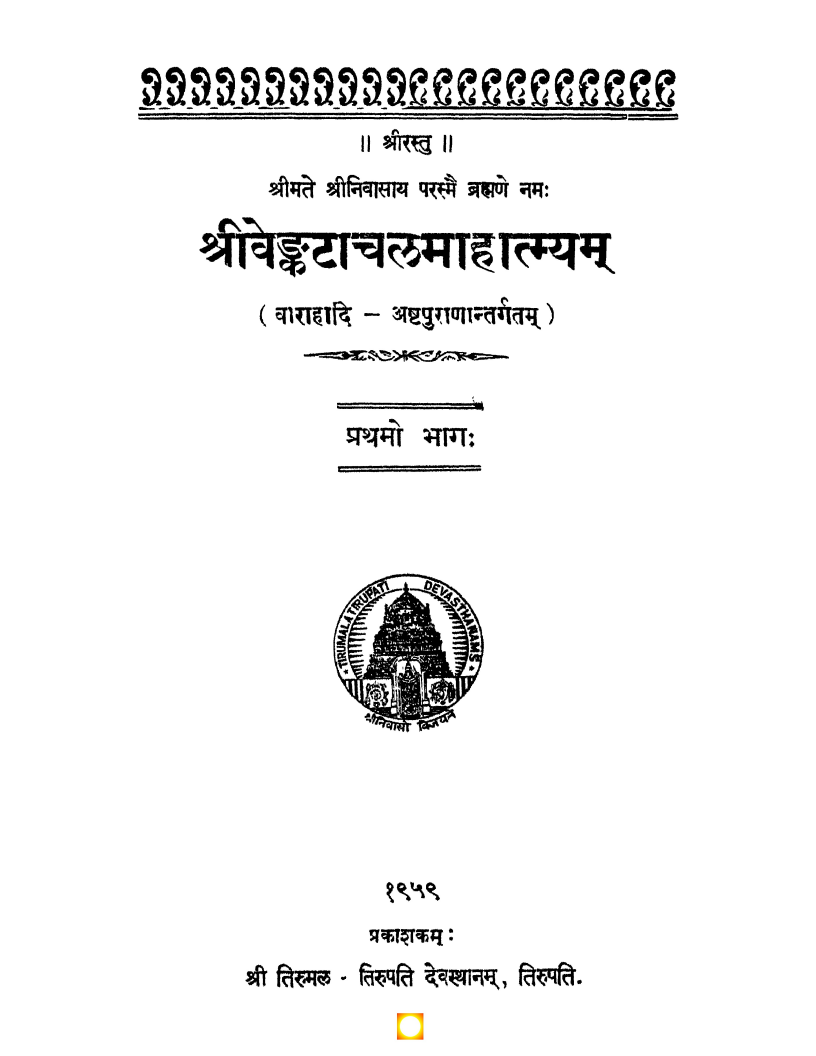
"SHREE VENKATACHALA MAHATMYAM", 2 Volumes, UNIQUE EDITION, Sanskrit, Tirumala Tirupati


VERY UNIQUE EDITION, HIGHLY RECOMMENDED

DOWNLOAD (Sanskrit):

YandexDisk  Cubby  Box  Dropbox  Bitcasa  GoogleDocs  Skydrive Copy  Yunio

Not to get perplexed in all the Editions I have uploaded this year, the 4 editions are present in my Library now: 

1. IN ENGLISH - "SKANDA PURANA", Book 002, VISHNU KHANDA, "SHREE VENKATACHALA MAHATMYA", English, Motilal Banasirdass, 1951 http://vishnudut1926.blogspot.ru/2014/09/skanda-purana-book-002-vishnu-khanda.html

2. IN ENGLISH - "SHREE VENKATACHALA MAHATMYAM, SRI VENKATACHALA ITS GLORY", ENGLISH, ENHANCED SCAN, G. V. Chalapati Rao, Tirumala Tirupati, 1983 - http://vishnudut1926.blogspot.ru/2013/10/shree-venkatachala-mahatmyam-sri.html

3. IN SANSKRIT - "SHREE VENKATACHALA MAHATMYAM", 2 Volumes, UNIQUE EDITION, Sanskrit, Tirumala Tirupati http://vishnudut1926.blogspot.ru/2014/01/shree-venkatachala-mahatmyam-2-volumes.html

4. IN SANSKRIT - "VISHNU-KHANDA" from Skanda-Purana including "SHREE VENKATACHALA MAHATMYAM", SANSKRIT - http://vishnudut1926.blogspot.ru/2013/10/vishnu-khanda-from-skanda-purana.html

"Gopala Sahasranama Stotram" with Bhagavadgunaratna Petika Tika, Sanskrit, Tirumala Tirupati, 1985


DOWNLOAD (Sanskrit with English Exordia):

YandexDisk  Cubby  Box  Dropbox  Bitcasa  GoogleDocs  Skydrive Copy  Yunio