The only Pramana which exists for me is just "Shree Lakshmi-Tantra", the Only Adored Goddess is Shreemati Lakshmi-Devi
пятница, 16 августа 2013 г.
"THE BRAHMASUTRA BHASHYA OF MADHVAACHARYA" with glosses of Shree Shreemad JayaTirtha, Shree Shreemad VyasaTirtha and Shree Shreemad RaghavendrAcharya (1911, 1915, 1920)
DOWNLOAD (SANSKRIT, 180 MB)
YandexFolder CubbyFolder BoxFolder DropboxFolder 4SyncFolder GoogleDrive
Skydrive Megacloud 4Shared
In separate files:
Volume 01 - https://copy.com/3oqgELvPxoL7
Volume 02 - https://copy.com/n4jdHpS7DG4C
Volume 03 - https://copy.com/tSXFYQCwZVAY
"THE PROCESS OF CREATION IN DASA SAHITYA", Tirumala Tirupati, 1999
YandexDisk Cubby Box Dropbox GoogleDocs Skydrive Ge.tt Mc.tt Copy
Usually I don't like the stories about Sarga at all, but don't be outfoxed by the name of the book, because it is actually not about creation.
A lot of elaborate ideas of Vaishnava-Acharyas are explained in the book.
I have been impressed by the Chapter about Shree Vaikuntha-Dhama from this Book 2 years ago.
T H I S S C A N B E L O N G S T O T H E F A M I L Y O F M Y C O M P A C T
V A I S H N A V A E - L I B R A R I E S , T H E Y C A N B E F O U N D O N :
Wordpress (a catalogue with pictures and cloud links to PDF-scans) - #Wordpress
Nimbus (this is just a TXT-version without pictures) - #Nimbus
Airborn (the mirror of Wordpress) - #Airborn
GoogleDocs (the mirror of Wordpress) - #GoogleDocs
Airborn (the mirror of Wordpress) - #Airborn
GoogleDocs (the mirror of Wordpress) - #GoogleDocs
"Vilapa-Kusumanjali - A Bouquet of Lamentations" by Shree Shreemad Raghunatha dasa Goswami lectures Ananta Dasa Babaji Maharaja
DOWNLOAD:
English annotation by Vishnudut1926: "Vilapa-Kusumanjali" is one of the most significant Prayers for Gaudiya-Sampradaya, because Manjari-Bhava is especially extolled in this Prayer.
The very similar text is "Sankalpa-Kalpadruma" by Shree Shreemad Vishvanatha Chakravarti Thakur.
There are 2 files in the folder:
1) The original Prayer
2) The lectures of Shree Shreemad Ananta Das Babaji, based on some verses of the Prayer
New Additions to my Flickr gallery
New Additions to my Flickr gallery - http://www.flickr.com/photos/98170374@N03/
The new Images can also be seen at minus, box, dropbox and copy.
Aspire to become servants of Shree Radhika (Radha-Dasya) only
The very distinctive feature of "Shree Brihad-Bhagavatamrita" is the division of bhakti-yogs into:
1) Gyana-bhaktas 2) Shuddha-bhaktas 3) Premi-bhaktas 4) Prema-Para-bhaktas 5) Prematura-bhaktas (see page 28 and further in the edition of Shree Shreemad Narayana Maharaj).
Manjari-Bhava is considered to be the highest achievent, that's why Verse 2.1.21-22 is the most heart-capturing Verse for all of us!!!!!!!!
"SHREE BRIHAD-BHAGAVATAMRITA", 2.1.21-22: "These devotees, being indifferent to all other spiritual practices and goals, aspire to become servants of Shree Radhika (Radha-Dasya) only.
To attain this service, they constantly sing Her Holy Names, immersed in divine love.
If these devotees, like other general devotees, obtain a special place in the same Vaikuntha, our hearts will not be satisfied.
Alas! I cannot tolerate the idea that Nanda and the other cowherdsmen and Yashoda and the cowherd women would have the same destination as ordinary devotees.".
DIG-DARSHINI-TIKA (COMMENTARY BY SHREE SHREEMAD SANATANA GOSWAMI): To present the destination achieved by those exceptional devotees, their distinction is being shown in these verses beginning with "ye".
Shree Uttara says, “These devotees develop complete detachment towards the happiness derived from the spiritual practices (sadhanas) and goals (sadhyas) of the five types of devotees mentioned earlier [verse 16].
Sacrificing all other practices and goals with a palmful of water – or in other words, renouncing them completely – they exclusively strive for the servitorship of Shreemati Radhika, the Most Beloved of Madana-gopala Shree Krishna.
Their singular aspiration is, ‘I want to be Shree Radhika’s maidservant.’ Upon obtaining that position, they automatically attain not only all their desires, but the results of desires beyond imagination.”
Thus with the words beginning with "sankirtayanti", Shree Uttara emphasizes how extraordinary that sadhana is that can grant such an extraordinary result.
“These devotees glorify the names of Rasa-Rasika Shree Krishna – He who enjoys the rasa dance – by performing "sankirtana", singing in sweet voices with ecstatic loving sentiment.
The lovingly performed nama-sankirtana, or chanting of the holy names, is imbued with overwhelming, natural love for the Lord.
Therefore, if their destination is the same as those of all other devotees, then our hearts will be filled with discontent.”
Here one may argue, “Just as Dvaraka and other abodes are present in Vaikuntha, Shree Mathura-Mandala is also present there.
And in Mathura is Shree Gokula. Let the devotees of Shree Rasa-Rasika enjoy pastimes with their beloved Lord as they wish in that Gokula.
Just as the Yadavas, commensurate with their sadhana, experience greater happiness than the Pandavas, similarly let the devotees of Rasa-Rasika Shree Krishna also obtain results befitting their sadhana and reside in the Shree Mathura Gokula of Vaikuntha.”
Here, the term "anyesham iva", meaning ‘like others,’ implies ‘like the Pandavas and Yadavas.’
"Tesham", meaning ‘of them,’ implies that devotees of Shree Rasa-Vihari Shree Krishna also attain the topmost happiness, commensurate to their sadhana.
Shree Uttara replies, “This, however, does not satisfy my heart. That level of happiness is generally very common.”
Another understanding of Shree Uttara’s words is:
“This may be the case, but if, by the influence of the great mercy of the lotus feet of Gopinatha Shree Krishna, those most affectionate and highly perfected personalities acheive the same destination, then so be it.
However, peerless personalities such as the gopas and gopis like Shree Nanda, Shree Yashoda, and their followers, the other residents of Vraja, possess paramount, unbounded love for Shree Krishna that is Eternal and Ever-Fresh. It is absolutely unacceptable that they would obtain a destination similar to others.”
This is communicated in the word aho, meaning ‘alas.’ She says, “Aho! It is unbearable for me to think that they would also obtain the same ordinary result as all other devotees. It is inappropriate to equate the majestic with the insignificant.”
понедельник, 12 августа 2013 г.
Of these two, I have an extreme repulsion for a person who has excessive affection for his relatives
I hate all my relatives, considering them to be mayik (the epithet "mayik" is too beautiful for them, because in reality my relatives are just stupid).
It is always more than necessary for bhakti-yog to be extremely educated in Gyana-Shastras.
The heart must be cold and compassion-and-emotion-void.
I suppose, that Bhakti-Yoga is not possible without Gyana and especially the awareness of everything being the illusion.
By the way, I also hate the idea of compassion, because it is just sentimental crap.
The following darshan of Shree Shreemad SwamiNarayan is incredible and very Gyana-imbued!
19.1 In the Samvat year 1884, on Shrãvan vad 13 [20th August 1827], Swãmi Shree Sahajãnandji Mahãrãj was sitting on a mattress with cylindrical pillow that had been placed on a decorated bedstead on the veranda outside the west-facing rooms of Dãdã Khãchar’s darbãr in Gadhadã.
19.3 “For this reason, a person who has abandoned worldly life should not keep even the slightest amount of affection for his relatives.
Therefore, a tyãgi bhakta of Bhagvãn should realise his own chaitanya to be distinct from both the body and the relatives of the body.
In fact, the relatives of this body should be considered together with the relatives of the 8.4 million types of previous life forms.
It is always more than necessary for bhakti-yog to be extremely educated in Gyana-Shastras.
The heart must be cold and compassion-and-emotion-void.
I suppose, that Bhakti-Yoga is not possible without Gyana and especially the awareness of everything being the illusion.
By the way, I also hate the idea of compassion, because it is just sentimental crap.
The following darshan of Shree Shreemad SwamiNarayan is incredible and very Gyana-imbued!
Gadhadã III – 19
Two Undesirable Traits Of A Tyãgi
He was dressed entirely in white clothes. Also, garlands of mogrã and karnikãr were hanging around His neck. A sabhã of munis, as well as haribhaktas from various places, had gathered before Him.
19.2 Then, Shreeji Mahãrãj said, “A bhakta who has abandoned worldly life may possess two negative traits which are not appropriate for him in this satsang; the first is lust and the second is affection for his relatives.
In my eyes, a person who possesses these two negative traits is like an animal. Of these two, I have an extreme repulsion for a person who has excessive affection for his relatives.
19.3 “For this reason, a person who has abandoned worldly life should not keep even the slightest amount of affection for his relatives.
This is because having affection for bodily relatives is a greater sin than the five great sins.
Therefore, a tyãgi bhakta of Bhagvãn should realise his own chaitanya to be distinct from both the body and the relatives of the body.
He should believe, ‘I am the ãtmã; I have no relations at all with anyone’.
In fact, the relatives of this body should be considered together with the relatives of the 8.4 million types of previous life forms.
If a person does try to understand the greatness of his relatives, knowing them to be satsangis, then since there is already some affection due to the fact that they are related, he develops more affection for them than he has for Bhagvãn and the bhaktas of Bhagvãn.
Therefore, if a person does keep affection for his relatives knowing them to be bhaktas of Bhagvãn, towards whom affection is natural, then his life becomes useless.
19.4 “Moreover, it is also natural for a person to develop affection for those who perform his sevã, even though they may not be his relatives.
So, a person who is wise should not keep affection towards a person who is serving him, even if that person happens to be a bhakta of Bhagvãn.
For example, if a snake has released venom into sweetened milk, the mixture also becomes poisonous.
Similarly, out of self-interest, a person should not keep affection towards someone who performs his sevã, even if the person serving happens to be a bhakta.
This is because his jeev becomes attached due to that sevã.
Then, just as he thinks about Bhagvãn, he also begins to think about the person who serves his needs.
For that person, this in itself is an obstacle in his worship of Bhagvãn – just as the young deer itself
becomes avidyã (mãyã) for Bharatji.
In this way, a bhakta of Bhagvãn should totally avoid all those who obstruct his worship of Bhagvãn, knowing them to be avidyã.”
19.5 Shreeji Mahãrãj then concluded by adding, “The paramhans and all the sãnkhya-yogi bhaktas should daily say and listen to this talk which I have just delivered.
Specifically, the senior member of a mandal should daily narrate this talk, and others should listen. If the senior person fails to do so, he should do upvãs on that day.
Those who do not come to listen to that talk of Bhagvãn with shraddhã should also do upvãs.
Please remember these words firmly in your lives.”
воскресенье, 11 августа 2013 г.
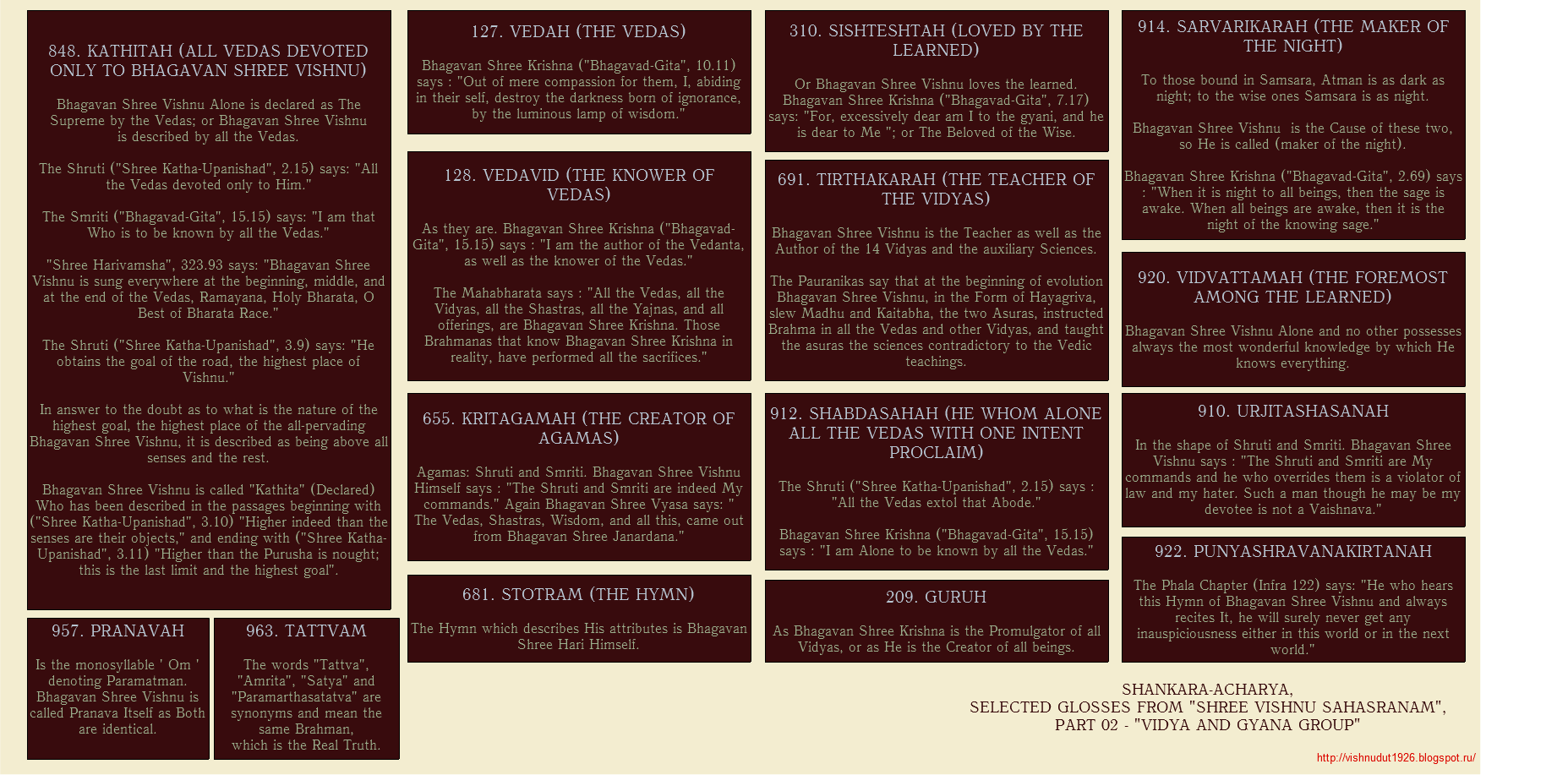
Shankara-Acharya, Selected Glosses from "Shree Vishnu Sahasranam", Part 02 - "VIDYA AND GYANA GROUP"
The first group was dedicated to Guhya, Gupta and Rahasya-Tattva - http://vishnudut1926.blogspot.ru/2013/08/shankara-acharya-selected-glosses-from.html
Now the second group "Vidya and Gyana".
The Name 848 of Bhagavan Shree Vishnu, that is "Kathitah" is more than important.
The gloss, Shree Shreemad Shankara has compiled to the Name of Bhagavan Shree Vishnu 848 is equal to Chatur-Shlokas of "Shreemad Bhagavatam" in terms of Siddhanta.
This chart can also be found at box, dropbox, ge.tt, minus, copy and flickr.
The chart font is "Antiqua"
Colour scheme:
Now the second group "Vidya and Gyana".
The Name 848 of Bhagavan Shree Vishnu, that is "Kathitah" is more than important.
The gloss, Shree Shreemad Shankara has compiled to the Name of Bhagavan Shree Vishnu 848 is equal to Chatur-Shlokas of "Shreemad Bhagavatam" in terms of Siddhanta.
This chart can also be found at box, dropbox, ge.tt, minus, copy and flickr.
The chart font is "Antiqua"
Colour scheme:
суббота, 10 августа 2013 г.
Dr. Ian Stevenson - Survey of Reincarnation cases in India, Asia and Africa
Ian Stevenson had compiled a lot of articles dedicated to reincarnation phenomenons in India and other countries.
All the articles can be reviewed here - http://www.medicine.virginia.edu/clinical/departments/psychiatry/sections/cspp/dops/publications-page
What differs Stevenson from sentimental New Age dorks is that he uses only scientific proofs and, for example, he says that hypnotic regression in past life (which is very popular in the West) is a hoax and sham.
I will dwell on 6 articles, which I found the most impressive.
01_STE29 - "A Case of the Possession Type in India With Evidence of Paranormal Knowledge"
This one of the most impressive article. The brahman woman has been killed, but her soul possessed the body of illiterate village woman. I recommend to read all the article, because this case is really incredible.
02_STE22 - "Near Death-Experiences in India"
This article is impressive too and it is of particular interest for Vaishnava, because cases of meeting with Yamaraj are described here.
03_STE52 - "Unusual Play in Young Children Who Claim to Remember Previous Lives"
A lot of cases are described (from page 5).
04_STE31 - "A case of a limbless child"
This case proves the strict karma laws.
05_STE39 - "Wounds from previous life are correlated with the birthmarks in the current life"
06_STE43 - "6 Modern Apparitional Experiences"
I would not believe these stories, but on the funerals of my mother one of the guests told us the story, resembling the story from Case 1.
Shankara-Acharya, Selected Glosses from "Shree Vishnu Sahasranam", Part 01 - " GUHYA-GROUP"
I have selected the most impressive glosses of Shree Shreemad Shankara-Acharya to "Shree Vishnu-Sahasranam".
I have compiled the glosses in groups. The first group had been called "Guhya" by me and it is devoted to Guhya, Gupta and Rahasya-Tattva.
I have compiled the chart, which can be found on my Flickr, box, dropbox, minus, copy and below!
I have compiled the glosses in groups. The first group had been called "Guhya" by me and it is devoted to Guhya, Gupta and Rahasya-Tattva.
I have compiled the chart, which can be found on my Flickr, box, dropbox, minus, copy and below!
Bhagavan Shree Krishna and Atasi Flower
Usually Shree Krishna writes in all the Puranas that He is Black (Black Kali-Yuga Avatara), but the devotees perfectly know, that Our Beloved Bhagavan is of very Tender Blue Colour.
By the way, this confusion with colours greatly impairs asuras and Shree Shreemad Jiva Goswami, in "Bhagavad Sandarbha", cites their silly judgments about Shree Krishna, which they make, jumping to the conclusions about Krishna being Nila (Black), Kali (Black) or even Krishna (which also can be translated as "black" from Sanskrit).
Shree Shreemad Shankara-Acharya, in His gloss to the Name NO. 1000 of Bhagavan Shree Vishnu, cites the following verses (page 160 in the English translation):
"Even one salutation heartily rendered to Bhagavan Shree Krishna is equal to ten horse-sacrifices duly performed.
He who has performed ten Ashvamedha sacrifices is again born, but he who salutes Bhagavan Shree Krishna is not. There is no fear to those who bow down before Govinda whose colour resembles that of Atasi flower, who is undecaying and clad in white garment.
The sins committed by man in his past births, in thousands of Kalpas and Pralayas, are immediately destroyed by slightly bowing down his head before the Lord of Three Lokas, the Supreme Lord, Bhagavan Shree Vishnu of uncomparable excellence".
Now, some information about Atasi Flower from http://www.flowersofindia.net/mythology.html
"Atasi अतसी (Linum usitatissimum)
This pretty blue flower is popular in Sanskrit literature for comparing with the complexion of Krishna.
A famous sloka in Krishna's praise goes अतसीपुष्पसंकाशम् हारनूपुरशोभितम् "atasii pushpa sankaasam haara noopura shobhitam".
This flower, along with the blue butterfly-pea flower, Aparaajita, is also popular in worship of Goddess Durga (who is also sometimes considered an "amsha" (अंश) of Krishna).
Distressing NDEs and Mayavada-preaching entities
NDE means "near-death experience".
As you know, such scientist as R.Moody has written popular books regarding NDEs (including very popular book "Life After Life").
Nancy E. Bush explores the same theme, but with a funereal twist, because she is interested in the so-called "NNDE" (negative near-death experiences).
The following is the excerpt from her 1992 year article from "Psychiatry" magazine.
The most funny part of the article is the encounters with Mayavada-preaching (or Buddhism-preaching) entities in NDE.
In the following excerpt 3 cases are described and the first one is the funniest of all.
Some scientists erroneously suppose that this life beliefs will determine NDE, but these cases prove otherwise, because two persons from stories were Presbyterian and Protestant, but their NDEs were scarily Buddhistic.
Nancy Evans Bush, excerpt from the article "Distressing NDEs" ("Psychiatry", Volume 55, February 1992)
Nonexistence or Eternal Void
The second type of distressing experience involves a paradoxical sensation of ceasing to exist entirely, or of being condemned to a featureless void for eternity.
Sometimes this type of experience includes a sense of despair that life as we know it not only no longer exists but in fact never did. that it was all a cruel joke.
Unlike the first type of distressing experience, these generally contain fewer features of the prototypical peaceful near-death experience and do not appear to convert to the peaceful kind with time.
Following are verbatim accounts of this type.
Example 01.
The first example was reported by an academic administrator, the daughter of Unitarian ministers, who had never heard of such experiences previously and believed she was the only person ever to have had one, unable to tell even her husband about it.
Her experience occurred during the delivery of her second child at age 28: the fetus had engaged and labor
had begun 3 weeks early, and she was sent to the hospital where three pitocin drips were started over the next 7 hours.
She described her mental state as fearful, depressed, ana panicky; finally she was given nitrous oxide:
I remember trying to fight the mask, but they grabbed my wrists and strapped them. First there was only unconsciousness, but at some point farther into delivery my blood pressure suddenly dropped.
I was aware, not of the flurry around me, but of moving rapidly upward into darkness. Although I don't recall turning to look. I knew the hospital and the worid were receding below me. very fast: to this day my mind holds a sharp picture of them down there, though I don't know how I could so clearly have seen some-
thing 1 didn't look at. I was rocketing through space like an astronaut without a capsule, with immense speed and great distance.
A small group of circles appeared ahead of me, some tending toward the left. To the right was just a dark space. The circles were black and white, and made a clicking sound as they snapped black to white, white to black.
They were jeering and tormenting—not evil, exactly, but more mocking and mechanistic. The message in their clicking was: Your life never existed. The world never existed. Your family never existed. You were allowed to imagine it. You were allowed to make it up. It was never there. There is nothing here. There was never anything there. That's the joke-it was all a joke. There was much laughter on their parts, malicious.
I remember brilliant argumentation on my part, trying to prove that
пятница, 9 августа 2013 г.
Can the English translation of Gaudiya-Poetry be Rasika? Discussing "Chitra Kavitvani" by Shree Shreemad Rupa Goswami
"Chitra Kavitvani" is a very rare brochure. I have compiled the article devoted to "Chitra-Kavitvani" and some semantic problems, which are inevitably encountered by those English readers, who don't know Sanskrit.
Previously I have written that Sanskrit Poetry is very complicated and par excellence is immutably interwined with such concept as Alankara (Embellishment).
"Kavitvani" (कवित्वन - kavitvana) can be translated either as "Wisdom" or as "Poetic Gift" or "Poetic Genius" or "Poetic Artistry".
Actually, any person claiming to be a bhakti-yog in Gaudiya Parivara must be au courant in the poetic field.
The Rasika Path is the Path fraught with enormous danger, because it is basically enormously misunderstood and everyone must be on the qui vive, reading the Devotional Poetry of Gaudiya-Acharyas, because this Poetry is NOT so blunt and mundane as some harebrained buffons imagine it to be in their narrow-scoped heads.
The too literal and mundane interpretation of verses must be avoided and of course Bhagavan Shree Krishna is NOT primitive, plain, square simpleton, Who can be described as a lad living in Vrindavan, dancing from time to time and, excusez moi, eating sweet rice balls with friends.
Such simpletonic idea is obnoxious in all respects and of course it is not supported by Gaudiya-Acharyas.
If someone is really desperate to know about Bhagavan Shree Krishna, then one must study Six Sandarbhas of Shree Shreemad Jiva Goswami in which Shree Shreemad Jiva Goswami clearly states that Bhagavan Shree Krishna is Acintya (अचिन्त्य - acintya), Shuddha-Sattva, Agocara (अगोचर - agocara) LORD, WHO possesess SHAT-AISHVARYA (SIX UNIQUE DIVINE TRAITS) in a ne plus ultra degree.
Can the English of Gaudiya-Poetry translation be Rasika and what is "RasaSvadana"?
Splendid question, which entails the enormous bunch of problems, but before answering the question such term as "RasaSvadana" (or "RasaSvada" - रसास्वाद) must be explained.
In terms of Sanskrit Aesthetics "Rasa" can be vaguely translated as "Psychic and Spiritual experience", while "Svadana" translates like "the act of tasting".
If we use the simplified translation, then:
"Rasa" = "Juice, something, which can be tasted" and
"Svadana" = "to taste".
Aesthetic Svadana (tasting) is very complicated phenomenon, which consists of levels and sublevels of various psychic and emotional states (Bhavas, Anubhavas, Laya, Cittalaya and thousands of them).
Actually, the Devotional Poetry is the Juice and a bhakti-yog is a person who is endowed with capabilty to svadana (taste) this juice.
Why this happens? Everything is because of alankaras.
In fact, there is no proper way to render all the Sanskrit alankaras and poetic techniques in English and it's the problem of pitiful concern.
Imagine, that you are film-director and you have created the masterpiece movie. Imagine, that you have imbued every part of script and plot with special meaning and every part of movie is so important that it can't be amended at all.
But one day, out of blue, you find out that your masterpiece movie had been wrongly conveyed in movie theatres, because some scenes had been cut due to censorship, some music tracks had been changed and the voices of actors had been replaced to the foreign ones to make the movie suitable for international distribution.
Such situation actually happens with all the original Sanskrit Poetry.
Now, let's try to walk in the shoes of Sanskrit Author. When Sanskrit Authors had been creating the verses, they thought in Sanskrit and moreover, they supposed that only Sanskrit-speaking audience will be able to svadana (taste) this poetry.
That's why they have imbued their poetry with complicated puns, metaphors, allusions and thousands of other poetic tricks.
An example with "Bhkruti" (भृकुटी) from "Shree Ujvala-Nilamani".
Let's grasp the nettle and see at the example from "Shree Ujvala-Nilamani" by Shree Shreemad Rupa Goswami.
I do remember that in one of the verses of "Shree Ujvala-Nilamani" (I am sorry, but I can't find this verse now) one Gopi notices in jest, that the other Gopi is so reserved today, that she reminds a bhkruti (भृकुटी).
"Bhkruti" (भृकुटी) is a rare word and it means the special kind of frog in Sanskrit.
And actually, the word "Bhkruti" (भृकुटी) enormously alters the perception of the verse. It is just one word, but it entails the following bunch of the assosiations:
1. The word "bhkruti" is funny itself and of course it causes the enormous gust of laughter in reader, that is Hasya-Rasa.
2. This word also points out the fact that these Gopis are very bosom friends and there is no reservation in their jokes towards each other (Sakhi-Rasa).
3. In terms of alankara word "bhkruti" conjuncts with other homonyms in the verse, creating beautiful semantic pattern.
4. This word is interwined in the sound pattern of the verse.
So, as it is seen, just one word in just one verse entails the enormous scope of Bhavas and Rasas in the reader.
But what about English translation?
Can the word "bhkruti" conveyed in English? Of course not.
It will be just a "frog" and if the translator is responsible enough he may point out that the special pun with the word "bhkruti" had been used in this verse, but in a stern reality most of the Sanskrit-English translators don't provide remarks at all.
So, the elision of just one word "bhkruti" leads to overall alteration of the verse and, confusion worse confounded, the Sanskrit sound pattern is lost forever, which is a drawback of sorrowful significance too.
So, there are 2 points to remember:
1) Semantic and sound patterns are lost forever in Sanskrit-English translations.
2) The verses of Gaudiya-Acharayas don't imply literal reading, but they imply the complicated aesthetic apprehension instead and the ability to grasp metaphors, puns and various Sanskrit Alankaras.
I have compiled this article, because there are more and more strange translations of Gaudiya Poetry these days. Some of the translations are too dry and emotion-void, others, au contraire, too emotional and sentimental. And neither of them is good, speaking truly. The sentimental ones are worst of the kind, because they act as a trap for silly people who erroneously claim that "Bhakti is an emotion".
If Bhakti would be an emotion, then we would be able to train dogs of Pavlov to be bhakti-yogs, but Bhakti-Yoga is more complicated experience, which imply very high literacy and Gyana.
In order to plunge in the discussed theme further, I just recommend to refer to "Chitra-Kavitvani" and examples of exquisite and complicated Poetry construction of Shree Shreemad Rupa Goswami.
DOWNLOAD "Chitra Kavitvani" by Shree Shreemad Rupa Goswami :
Box Dropbox GoogleDocs Skydrive Ge.tt
So, there are 2 points to remember:
1) Semantic and sound patterns are lost forever in Sanskrit-English translations.
2) The verses of Gaudiya-Acharayas don't imply literal reading, but they imply the complicated aesthetic apprehension instead and the ability to grasp metaphors, puns and various Sanskrit Alankaras.
I have compiled this article, because there are more and more strange translations of Gaudiya Poetry these days. Some of the translations are too dry and emotion-void, others, au contraire, too emotional and sentimental. And neither of them is good, speaking truly. The sentimental ones are worst of the kind, because they act as a trap for silly people who erroneously claim that "Bhakti is an emotion".
If Bhakti would be an emotion, then we would be able to train dogs of Pavlov to be bhakti-yogs, but Bhakti-Yoga is more complicated experience, which imply very high literacy and Gyana.
In order to plunge in the discussed theme further, I just recommend to refer to "Chitra-Kavitvani" and examples of exquisite and complicated Poetry construction of Shree Shreemad Rupa Goswami.
DOWNLOAD "Chitra Kavitvani" by Shree Shreemad Rupa Goswami :
Box Dropbox GoogleDocs Skydrive Ge.tt
"SHREE LAKSHMI SAHASRAM", VOLUME 01, 04, 06, 07, 08, SANSKRIT, by Venkatadhwari with the Balabodhini Tika, Chowkhamba Sanskrit Series, 1904-1906
DOWNLOAD (SANSKRIT):
YandexDisk Cubby Box Dropbox AmazonCloud 4Sync GoogleDocs
Skydrive Ge.tt Mc.tt Mediafire 4Shared

To my dismay several Volumes are missing.
I have made an accordance "Volume to Number in Chowkhamba Sanskrit Series":
1) Shree Lakshmi Sahasram Volume 01 Sanskrit by Venkatadhwari with the Balabodhini Tika Chowkhamba Sanskrit Series 1904 - CHOWKHAMBA SANSKRIT SERIES NO. 84
4) Shree Lakshmi Sahasram Volume 04 Sanskrit by Venkatadhwari with the Balabodhini Tika Chowkhamba Sanskrit Series 1905 - CHOWKHAMBA SANSKRIT SERIES NO. 91
6) Shree Lakshmi Sahasram Volume 06 Sanskrit by Venkatadhwari with the Balabodhini Tika Chowkhamba Sanskrit Series 1905 - CHOWKHAMBA SANSKRIT SERIES NO. 96
7) Shree Lakshmi Sahasram Volume 07 Sanskrit by Venkatadhwari with the Balabodhini Tika Chowkhamba Sanskrit Series 1906 - CHOWKHAMBA SANSKRIT SERIES NO. 100
8) Shree Lakshmi Sahasram Volume 08 Sanskrit by Venkatadhwari with the Balabodhini Tika Chowkhamba Sanskrit Series 1906 - CHOWKHAMBA SANSKRIT SERIES NO. 104
So, the missing Volumes 02, 03, 05 must be somewhere in 85 - 95 Chowkhamba Sanskrit Series.
Vishnudut1926, 3:41 10.08.2013
Laxmi Narayana Mandir, Dehli (Birla Temple)
The colour scheme of Laxmi Narayana Mandir is my favourite one!
Noble brown with sandy shades!
Information about the Temple from http://www.culturalindia.net/indian-temples/birla-mandir-delhi.html
"Laxminarayan Mandir is one of the major temples and landmarks of Delhi.
During 1933-39, Laxmi Narayan Temple was built by Mr. B.D. Birla of Birla Group of Industries, one of the famous business tycoons of India. Being constructed by the Birlas, the temple came to be known as Birla Temple.
Located on Mandir Marg near Connaught Circus in Delhi, the temple is easily accessible from the city by metro, local buses, taxis and auto-rickshaws.
Birla Mandir is first of the temples made by Birlas across the country and till date, the funds to support this temple come from Birla family.
The famous temple is accredited to have been inaugurated by Mahatma Gandhi in 1939.
At that time, Mahatma Gandhi kept a condition that the temple would not be restricted to the Hindus and people from every caste would be allowed inside. In those times, the condition was really worked upon; still people visit this temple with full devotion.
Laxminarayan Temple is dedicated to Lord Vishnu, the preserver and His Consort, Goddess Lakshmi. The architecture of the Temple looks imbibed from the Orissan Style.
The temple has tall spires and it looks magnificent raised in red sandstone. The tallest spire of the temple extends to the height of 165 feet whereas the additional spires lengthen to 116 feet. The exotic structure of the temple comprises sculptures, tall spires and Jali work making it a remarkable to behold.
Apart from the idol of presiding deity, the temple has remarkable idols of Goddess Durga, Lord Shiva, Lord Ganesha, Lord Rama and Lord Hanuman. Geeta Bhawan is a huge hall that is embellished with striking paintings, derived from the scenes of Indian mythology.
On the rear end, one can trace gardens and fountains in the temple complex. The two-storied verandahs, on the three sides, are overlooked by the interior court.
For tourists, temple authorities have made adequate arrangements of guest house in its complex. Many International scholars come here to learn about the Hindu religion and for the time, they usually stay in the guest house of Birla Temple.
Every year, Janmashtami (birthday of Lord Krishna) is celebrated with full gusto and fervor in this temple. In fact, Birla Mandir is famous for its celebration of Janmashtami. People in large number come to visit this temple of spiritual legacy".
"SHREE LAKSHMI SAHASRAM", Sanskrit with English Exordia and Yantras (at the last pages of the book), Shree Ramanuja Seva Trust, 1988
DOWNLOAD (SANSKRIT WITH ENGLISH EXORDIA AND YANTRAS):
English annotation by Vishnudut1926: Rahu-Venus Dasha is especially important for Raganuga-Bhaktas, because Bhagavan Shree Chaitanya Mahaprabhu has revealed His most elevated Leelas in this Dasha.
This summer I have entered Rahu-Venus-Venus antardasha and the result was shocking.
Earlier I was 100% worshipper of Bhagavan Shree Vishnu, but now my Sadhana is 90% devoted to Shreemati Maha Lakshmi Devi and to Shreemati Radharani Devi.
The rest 10% is devoted to Krishna.
Later I will post an article about my spiritual growth and, the silly thing from my side: I have totally overlooked that Venus is in 5th House in my Rasi.
5th House is the House of Bhakti, and Venus in 5th house indicates either the worshipper of Shreemati Lakshmi-Devi and Shreemati Radharani-Devi or a person belonging to Shakta-Tradition.
Anyway, I don't like the name "worshipper", because I love Shreemati Lakshmi-Devi as younger sakhi loves older Sakhi and our girlish love is mutual. This is the essence of Manjari-Bhava, which is strictly followed in Gaudiya-Sampradaya.
Yes, I know, I should have written the annotation to the Book, but I have written love confession instead.
This Book is more than precious and if you like it, you should also learn by heart such Bhakti Masterpieces as "Ashta Lakshmi Stotram" and "Maha Lakshmi Prapatti".
Annotation from the book:
"LAKSHMI SAHASRAM" is a classic Sanskrit Kavya composed of 1013 verses in praise of Goddess Maha Lakshmi, in terse Sanskrit, replete with excellent grammatical, philosophical, literary and devotional expressions of great thoughts contained in the Upanishads, Epics & works of Poorvacharyas.
The Dvaya-Mantra of Shree Vaishnavas, consisting of 25 letters, has been expanded into 25 slokas by Shree Vedanta Desika in Srhree Stuti.
The same has been further elaborated by Mahakavi Arasanipalai, Venkatadhwari in this classic, into 25 chapters called "Stabakas" which amply testify that his mastery in all branches of higher learning viz. Tarka, Vyakarana, Mimansa, Vishistadvaita Vedanta & Alankara is par excellence.
"SHREE VISHNU SAHASRANAMA", ENGLISH-SANSKRIT, with the Bhashya of SHANKARA-ACHARYA, Adyar, Madras, 1927
The variant of Shankaracharya had been deleted and replaced with pure Vaishnava Tikas by Shree Parashara Bhatta Acharya from Shree Ramanuja-Vaishnava-Sampradaya, see the scan here - http://vishnudut1926.blogspot.com/2017/12/sri-vishnu-sahasranama-with-bhashya-of.html
"UJJVALA-NILAMANI" SANSKRIT, reprint edition 1985, reprinted from 1932 edition of Kavyamala 95
This is a part of my very old E-Library. In 2017 this segment had been replaced by the NEW VAISHNAVA E-LIBRARY, which can be found on:
Wordpress (a catalogue with pictures and cloud links to PDF-scans) - #Wordpress
Nimbus (this is just a TXT-version without pictures) - #Nimbus
Airborn (the mirror of Wordpress) - #Airborn
GoogleDocs (the mirror of Wordpress) - #GoogleDocs
Airborn (the mirror of Wordpress) - #Airborn
GoogleDocs (the mirror of Wordpress) - #GoogleDocs
"Stava Kalpadrumah" (Stavas of Gaudiya Sampradaya), Sanskrit
DThis is a part of my very old E-Library. In 2017 this segment had been replaced by the NEW VAISHNAVA E-LIBRARY, which can be found on:
Wordpress (a catalogue with pictures and cloud links to PDF-scans) - #Wordpress
Nimbus (this is just a TXT-version without pictures) - #Nimbus
Airborn (the mirror of Wordpress) - #Airborn
GoogleDocs (the mirror of Wordpress) - #GoogleDocs
Airborn (the mirror of Wordpress) - #Airborn
GoogleDocs (the mirror of Wordpress) - #GoogleDocs
понедельник, 15 июля 2013 г.
15:21, 15 July 2013
I have returned to my Art this summer and I am going to paint pictures of Shree Krishna.
The July and August will be very much events-imbued, because I am all crazy about my Yoga programme, Art Lessons and Krishna Books!
I am reading "Shree Vishnu-Sahasranam" with the Tika by Shree Shreemad Shankara-Acharya now and this Book is masterpiece!!!!!!!!!!!
I will upload the Book later and I am going to start learning this Book by heart.
The first image of Shree Krishna will be in very cold icy blue pallette.
I am going to add some raspberries and blackberries to this image.
I have the idea of painting a bunch of Shree Krishna Images with berries, because Shree Krishna and His Mood (Vrindavan Bhava) are perfectly comply with the images of various berries, especially the vines of raspberries and blackberries.
And I am playing music for Shree Krishna in C # Major scale today!
The July and August will be very much events-imbued, because I am all crazy about my Yoga programme, Art Lessons and Krishna Books!
I am reading "Shree Vishnu-Sahasranam" with the Tika by Shree Shreemad Shankara-Acharya now and this Book is masterpiece!!!!!!!!!!!
I will upload the Book later and I am going to start learning this Book by heart.
The first image of Shree Krishna will be in very cold icy blue pallette.
I am going to add some raspberries and blackberries to this image.
I have the idea of painting a bunch of Shree Krishna Images with berries, because Shree Krishna and His Mood (Vrindavan Bhava) are perfectly comply with the images of various berries, especially the vines of raspberries and blackberries.
And I am playing music for Shree Krishna in C # Major scale today!
Подписаться на:
Комментарии (Atom)